articles
Fall Back & Adjusting Your Baby’s Sleep For The End of Daylight Savings


Quick Take: The end of Daylight Saving Time 2025 happens on Sunday, November 2nd at 2:00 am. Use one of these three proven strategies to adjust your baby’s sleep schedule and prevent early morning wake-ups after the fall time change.
In September, I start getting questions about the end of Daylight Savings and how to adjust baby sleep for the time change…
How is the time change going to affect my baby?
How do I prevent an early morning wake-up from the time change?
Why do we even do this?
These are great questions and this article will answer all but the last one! Here’s my take on that one…
Daylight savings is ridiculous and antiquated. There’s been talk that many states are considering permanent daylight savings time or permanent standard time. Unfortunately, no states have adopted legislative changes as of the date of this post. We can certainly keep the hope alive because parents have enough daily challenges to navigate without throwing in a time change!
When Does Daylight Saving Time End in 2025?
The end of Daylight Saving Time 2025 is on Sunday, November 2, 2025 at 2:00 am when we turn the clocks back one hour. This means when your child wakes at their normal time on that Sunday, say at 6:30 am, according to the new time, it will actually be 5:30 am! 😱
If you and Taylor are on the same page, let’s get you hooked up with the insight you need to prevent your little one from waking at an ungodly hour. Here’s my guidance on adjusting your baby’s sleep schedule for the fall time change…
How the Fall Time Change Affects Baby Sleep
For some children, this transition is easy peasy. And for others it can completely derail sleep, at least temporarily. Here’s why:
When the time change happens and we set the clock back one hour, it doesn’t adjust our child’s internal clock. This means your child will wake at their normal time, but this will actually be one hour earlier than usual.
Earlier wake times can throw off both naps and bedtime, affecting the ability to sleep and sleep quality. This can result in a cycle of your child becoming overtired and cranky. (I don’t know about you, but a too early wake time makes me cranky too!)
When children get overtired it usually results in bedtime battles, night wakings, restless sleep, early morning wake-ups, and difficult naps. “Oh goody!” said no parent ever.
To help make the adjustment as easy as possible on your child AND you, you’ve gotta have a plan! That plan may be winging it and that’s ok! But if winging it creates anxiety and cues panic, let’s get you prepared on how to create a plan.
Your Early Morning Wake-Up Prevention Plan
To help make this process as seamless as possible, it is helpful to choose the right fall back adjustment strategy based on your family’s unique situation. Use these steps to choose the right plan for your family:
Step 1: Read all 3 of the daylight savings strategies below
Step 2: Choose the strategy that aligns most with your child’s temperament, while also considering your parenting and lifestyle.
Choosing the right strategy can help you to navigate the end of Daylight Saving Time and help keep your little one well-rested through the time change.
Quick Comparison: Which Strategy Is Right for Your Baby?
| Strategy | Best For | Time Investment | Adjustment Period |
|---|---|---|---|
| Stay the Course | Flexible sleepers, late risers | None | 2-3 days |
| Slow & Steady | Sensitive sleepers, early risers, babies under 8 months | 7 days before | Minimal |
| Meet in the Middle | Busy families, moderate sleepers | 2-3 days before | 5-7 days |
Strategy #1: Stay the Course (No Preparation Needed)
Which child will benefit from this strategy?
- Your baby or toddler sleeps well and is flexible
- Your child is sleeping too late
If your child easily adapts to change and is a champion sleeper, you may not need to make any schedule adjustments.
What to Do:
Stay on your existing schedule times after the time change.
For example, if your baby or toddler goes to bed at 7 pm, you’ll want to keep that bedtime after the change. This will result in stretching your child a little bit – to what was previously 8:00 pm. Within a few days after the time change, your child should likely adapt to the new schedule. Your child may have a couple of off-sleep days but should get back on track quickly.
This is a great strategy for a child who loves to sleep in (lucky you!) and you’d like your child to wake earlier. The time change will bump their wake time one hour earlier.
Strategy #2: Slow and Steady (Gradual 7-Day Adjustment)
Which child will benefit from this strategy?
Your child…
- Is sleeping well, but is not flexible
- Wakes too early
- Is 8 months or younger
Did your child transition well with Daylight Savings Time in the spring?
Does your child struggle with adjusting to changes in their sleep schedule?
If you answered yes, you’ll want to look at making slow and steady changes in adjusting your child’s schedule.
Also, if your child is a perpetual early bird – waking before 6:00 am – or 8 months old or younger, they’ll also likely benefit from a gradual shift.
What to Do:
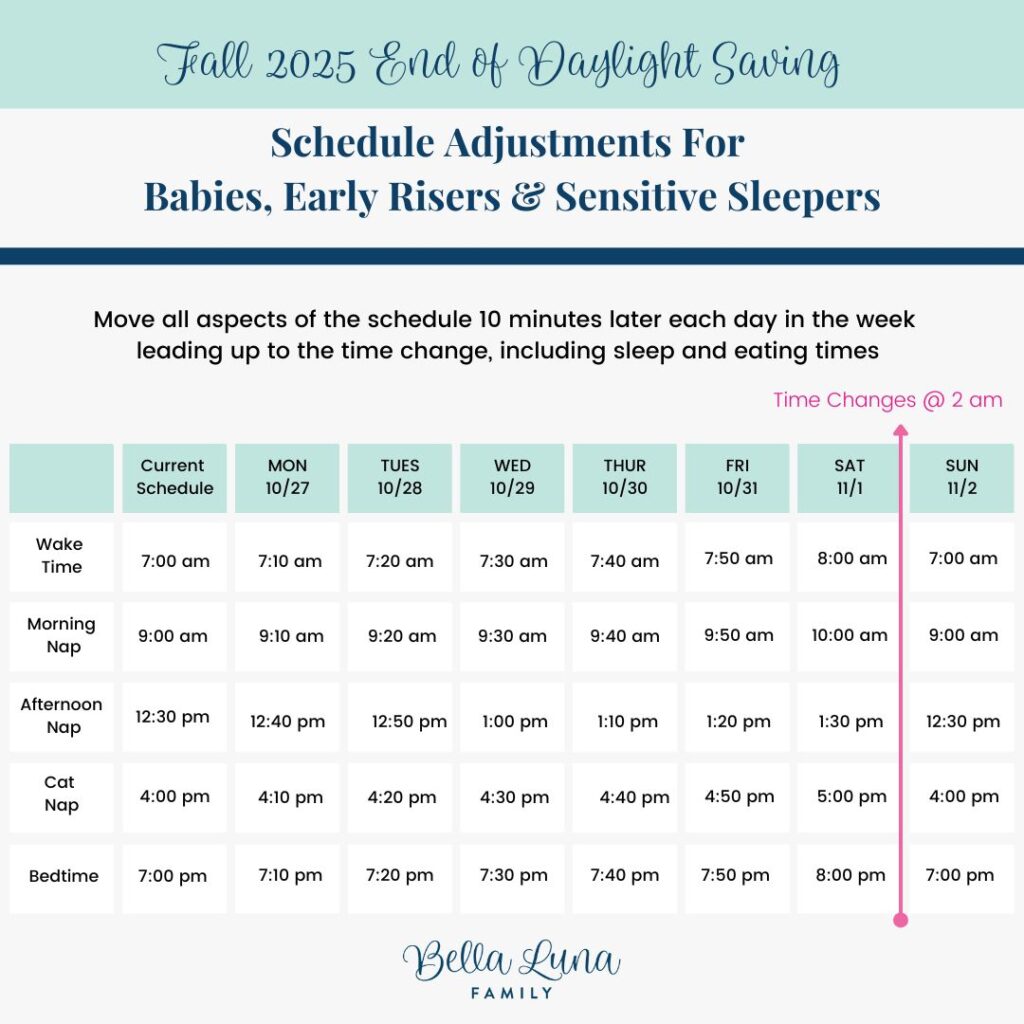
You’ll start moving your child’s entire sleep schedule later by 10 minutes every day in the 7 days leading up to the time change.
The thought behind this strategy is that by the time change, your child will be fully transitioned to the same schedule even though the time changed.
For example, if your child currently wakes at 6:30 am and you’d like to keep this wake time, start by moving the schedule later (wake time, naps and bedtime and all feedings).
With the slow and steady change, your little one will hopefully begin waking at 7:30 am by the time change occurs. When the time change finishes, your child should be waking up around 6:30 am and it won’t have any major impact on the schedule, resulting in sleep falling apart.
Use this chart as a guideline on how to make a slow & steady adjustment:
Strategy #3: Meet in the Middle (Quick 2-3 Day Adjustment)
Who will benefit from this strategy?
Parents who don’t have the time (or patience!) for a gradual change
What to Do:
Essentially, you will move your child’s entire schedule later by 20-30 minutes in the 2-3 days leading up to the time change.
For example, on Thursday, Friday and Saturday leading up to the time change, you will move your little one’s schedule 20-30 minutes later for all sleep periods and feedings. Once the time change is complete, you only have a 30-minute sleep delta to work through.
After the time change, begin working on moving your little one to the same schedule as before the time change. You can do this by introducing sleep at their normal times.
Within a week or so after the time change, your child should move back to their original wake time and original schedule before the time change.
Essential Sleep Tips for Daylight Saving Time 2025 (All Strategies)
Manage light exposure strategically: If your child wakes early after the time change, don’t take them out of their room and expose them to light before your desired wake time. Light tells our body it is time to be awake and if you want your child to adjust to the new time, delaying light exposure can help expedite the transition.
Get morning sunlight: Once it is your desired wake time, now the sun is your BFF is adjusting your little one’s internal clock. Exposure to sunlight is the most effective tool for resetting the body to the new time. I recommend getting outside shortly after the desired wake time for the first week after the time change. (This is a great strategy to practice regularly – morning light exposure can really help with sleepy hormone production)
Optimize darkness: Optimize your child’s sleep environment to ensure it is dark – this article provides tips and tricks on achieving optimal darkness. This will also help to reset your child’s internal clock.
Shift the entire routine: When using Strategy 1 and 2 above, ensure that you shift all aspects of your routine later. This includes feedings, naps, and bedtime so everything falls into the adjusting schedule.
Be patient: Young children love consistency and need time for their bodies to adjust. The adjustment may take a week or so to fully adapt no matter which strategy you choose.
Already dealing with early wake-ups? If your child is a perpetual early bird (before 6 am) already and you are SCARED of what may happen with the time change, consider taking our mini-course, Troubleshooting Early Morning Wake-ups. It’s less than a week of coffee runs and can make a HUGE impact!
FAQ: Baby Sleep and the Fall Time Change
How long does it take for a baby to adjust to the time change?
Most babies and toddlers adjust to the fall time change within 3-7 days, depending on which strategy you use and your child’s temperament. Flexible sleepers may adapt in 2-3 days, while sensitive sleepers might need the full week.
Should I wake my baby early to prepare for the time change?
No! Instead of waking your baby early, shift their entire schedule (including wake time, naps, feedings, and bedtime) later by small increments leading up to the time change. This helps their internal clock adjust naturally.
What if my baby already wakes up too early?
If your baby is already an early riser (waking before 6:00 am), use the Slow and Steady strategy to gradually shift their schedule. The time change can actually make early wake-ups worse, so preparation is key. Consider our Troubleshooting Early Morning Wake-ups course for targeted help.
Do newborns need special time change adjustments?
Babies under 8 months old benefit most from the gradual Slow and Steady approach since their sleep patterns are still developing and they’re less flexible with schedule changes. Newborns under 12 weeks may not need any adjustment at all since their schedules are still forming.
Can I combine different strategies for naps and bedtime?
While it’s best to keep your approach consistent, if you need to be flexible, focus your adjustment efforts on bedtime and morning wake time first. Naps will typically follow once the overnight sleep is adjusted.
Need More Help with the Time Change?
We hope these Daylight Savings Time 2025 sleep tips help!
If you need help navigating the time change for your child or any other sleep challenge, please schedule a discovery call where we can learn more and discuss how we can help you meet your sleep goals!
P.S. Want to stay connected?
Sign up to receive our monthly "Scoop" email newsletter!