articles
Baby Won’t Sleep Suddenly? Complete Regression Survival Guide (Newborn to 5 Years)


I still remember the night the 4-month sleep regression hit. Sleep was already challenging with my twin boys, who were waking ALL. NIGHT. LONG. Then suddenly we were back to the newborn days and they were waking even more than they had been. I didn’t think it could get any worse!
I found myself sitting on the nursery floor at 3 am, one baby in each arm, tears streaming down my face, frantically googling “why won’t my babies sleep suddenly” on my phone. If you’re reading this in the glow of your phone screen while your little one refuses to sleep, I want you to know: I’ve been exactly where you are, and there IS a way through it.
As a sleep consultant and twin mom who’s been through these exhausting phases multiple times (often simultaneously!), I can tell you that understanding what’s happening and when to expect these bumps in the road can make all the difference. Let’s break down the complete sleep regression timeline from 4 months to age 5. 🧸
Jump to Your Child’s Age:
- 4-Month Sleep Regression
- 8-Month Sleep Regression
- 12-Month Sleep Regression
- 18-Month Sleep Regression
- 2-Year Sleep Regression
- 2.5-Year Sleep Regression
- 3-Year Sleep Regression
- 4-5 Year Sleep Regression
- When to Seek Help
Or continue reading for the complete timeline to understand your child’s entire sleep journey and be prepared for what’s coming next!
What Are Sleep Regressions? Understanding the Key Sleep Regression Signs
Sleep regressions are temporary periods when a baby or child who was sleeping well suddenly starts waking more frequently at night, fighting naps, or experiencing other sleep disruptions. These regressions typically coincide with developmental milestones, growth spurts, or changes in sleep needs. Think of them as adjustments your child’s brain and body need to make when they’re learning big new skills – which explains why your baby or toddler won’t sleep suddenly despite previously being a champion sleeper.
The key word here? Temporary. Remember that these phases do pass—even when the nights feel endlessly long and your coffee intake reaches concerning levels.
Let’s dive into what happens during each major development-related sleep disruption and how you can survive them with your sanity (mostly) intact.
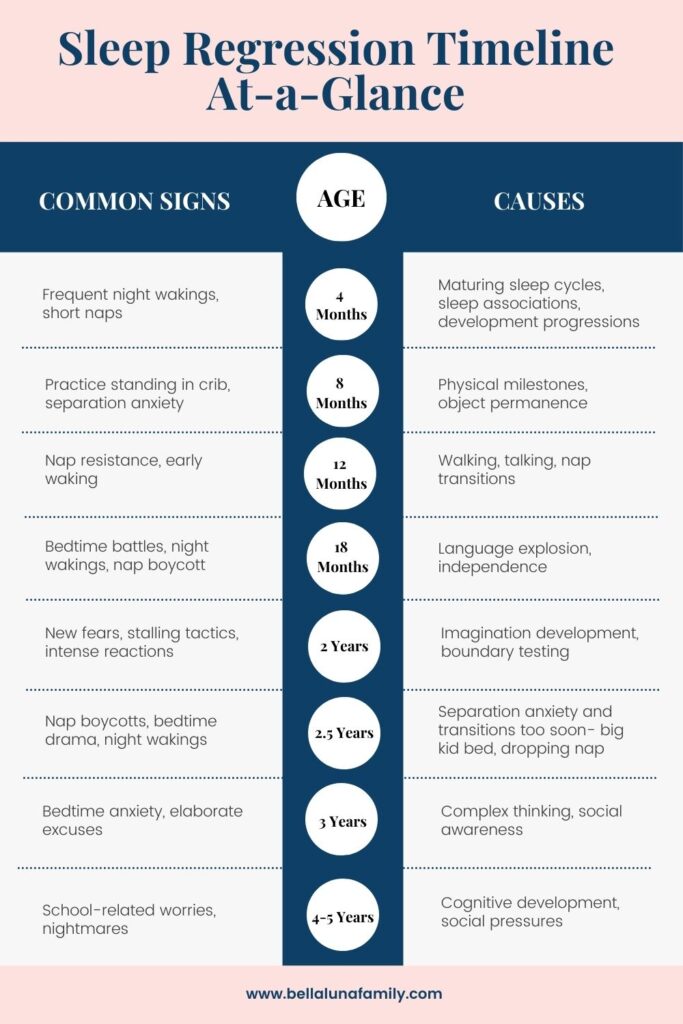
Sleep Regression Timeline at a Glance
Pin this chart for a quick reference when your little one’s sleep suddenly changes!

4-Month Sleep Regression (3-5 months)
The 4-month sleep regression is often considered the most challenging because it represents a permanent biological change in how your baby sleeps.
What’s happening: Your baby’s sleep cycles are maturing to become more adult-like. Instead of falling immediately into deep sleep, they now cycle through light and deep sleep phases. This biological shift means they’re more likely to wake between sleep cycles, especially if your little one doesn’t have the skill of putting themselves to sleep and relies on you to settle and resettle.
Additionally, around this time, babies become much more aware of their surroundings, which can make it harder for them to settle in environments with distractions.
Signs to watch for:
- Increased night wakings (sometimes every 45 minutes!)
- Shorter naps, often just 30-45 minutes long
- More fussiness and overtiredness
- Increased hunger
- Difficulty falling asleep independently if they previously could
Tips for survival:
- Begin introducing independent sleep skills if you haven’t already – we can help with this if your baby really struggles with putting themself to sleep!
- Consider implementing a more structured schedule with age-appropriate wake windows
- Make sure your baby is getting enough daytime feedings to reduce nighttime hunger
- Ensure the sleep environment is optimized (dark room, white noise, comfortable temperature)
- Consider a bedtime routine that includes a feed, then books/songs, to separate eating from sleeping
For a deeper dive into this critical sleep phase and even more survival strategies, check out our comprehensive guide to the 4-month sleep regression.
Remember, this isn’t really a regression—it’s a progression! Your baby’s brain is developing exactly as it should, even if it temporarily wreaks havoc on your sleep. ✨

8-Month Sleep Regression (7-10 months): When Separation Anxiety Sleep Problems Begin
Just when you think you may have gotten it figured out and your baby won’t sleep suddenly again, it’s likely the 8 month sleep regression!
What’s happening: This regression coincides with exciting physical milestones! Your baby is likely learning to crawl, pull up to standing, or maybe even taking their first steps. Their brain is busy processing these new skills and maybe they are practicing in their crib when they should be sleeping!
Many babies also experience heightened separation anxiety around this time, making bedtime and nighttime wakings more challenging emotionally. This separation anxiety sleep phase is often the first time babies truly understand that you exist even when they can’t see you – a concept called object permanence – which makes them want to confirm you’re nearby repeatedly throughout the night.
Signs to watch for:
- Practicing new skills in the crib instead of sleeping (the midnight pull-up parties are real!)
- Standing in the crib and not knowing how to get down
- Increased separation anxiety and crying when you leave the room
- More night wakings or early morning wakings
- Resisting naps they previously took easily
Tips for survival:
- Give plenty of physical practice time during the day to master new skills
- Teach your baby how to sit and lie down from standing (physically guiding them during daytime practice)
- Maintain consistent bedtime routines to provide security – this isn’t the right time to change up the routine. Your little one needs that consistency to deal with all the internal changes that are happening
- Consider slightly earlier bedtime to account for overtiredness – as early as 5:30-6:00 pm if your child is overtired
- Introduce games like peek-a-boo during the day to help with separation anxiety
From my experience: One of my twins hated naps! He was in his crib crawling around and pulling to stand and getting frustrated he couldn’t get back down. What helped most was extra physical activity during the day and physically showing them how to get down from standing position multiple times each day.
Need more specific strategies for surviving this challenging phase? Our complete guide to the 8-month sleep regression offers a step-by-step action plan that’s saved many parents’ sanity!
12-Month Sleep Regression (11-13 months)
As your baby approaches their first birthday, another sleep disruption commonly occurs and normally we see a major nap boycott that leads parents to think that their little one is ready for one nap. Not so fast!
What’s happening: This regression often coincides with walking, talking, and other major developmental leaps. This is also a peak time for another separation anxiety burst.
The one-year mark also often brings changes in routine—perhaps starting daycare, weaning from breastfeeding, or transitioning from formula to cow’s milk—all of which can impact sleep.
Signs to watch for:
- Boycotting naps
- Difficulty falling asleep at bedtime
- Early morning wakings (hello, 5 AM!)
- Increased separation anxiety
- More nighttime waking, often seeming disoriented
Tips for survival:
- Keep two naps – this is a regression, not a sign your little one is ready for one nap
- Maintain consistent bedtime routines to provide security during transitions
- Offer extra comfort for separation anxiety while still encouraging independent sleep
- Move bedtime earlier – if your child isn’t sleeping well for naps, compensate for that loss of sleep with an earlier bedtime
Our journey: We stuck with offering two naps and if they didn’t take one or both or if they were short, we did a 6:30-ish bedtime. Once the regression was over, the two naps came back (most of the time!) and they continued two naps until they were 18 months old! It’s worth it to stick with it!
Wondering if what you’re experiencing is actually the 12-month sleep regression? Our detailed guide on the 12-month sleep regression helps you identify the signs and implement effective solutions.

18-Month Sleep Regression (17-20 months)
The 18-month sleep regression often catches parents by surprise and can be particularly challenging. Your baby is now a toddler and this sleep regression comes with toddler ferocity!
What’s happening: Your toddler is experiencing an explosion in language development and independence. They’re testing boundaries, asserting autonomy (“NO!” becomes their favorite word), and it’s another common peak of separation anxiety. All this mental development impacts sleep.
Signs to watch for:
- Bedtime resistance and tantrums (sometimes epic ones!)
- Calling out for parents repeatedly after being put to bed
- Nighttime waking with difficulty returning to sleep
- Nap refusal or shortened naps
- Increased clinginess during the day
Tips for survival:
- Stay consistent with limits and boundaries (this is crucial)
- Offer appropriate choices to give a sense of control (“Do you want the blue or green pajamas?”)
- Keep bedtime routines predictable and calming
- Consider using a comfort object like a special stuffed animal
- Be patient and remember this developmental leap is important for their growing independence
A moment of honesty: The 18-month regression hit us HARD in our house. My twins had a lot of opinions on sleep and turned into bedtime terrorists overnight. What worked for us was staying very calm and not reacting to their BIG protests. If they woke at night, we responded consistently, while insisted on independent sleep.
The 18-month sleep regression can be especially challenging – that’s why we’ve created a focused guide with specific strategies for this difficult phase. Many parents have told us this resource was a lifesaver!

2-Year Sleep Regression (23-25 months): The Peak of Toddler Sleep Problems
All of a sudden your toddler turns 2 and the wheels come off the sleep bus. You may be thinking that there is something really wrong based on the intensity and longevity of your child’s protests at bedtime or nighttime.
What’s happening: Your toddler’s imagination is blossoming, which can lead to fears and nightmares. They’re also testing boundaries and asserting independence like never before.
Additionally, many children are going through significant language development, potty training, or transitioning to a toddler bed around this time—all major changes that can affect sleep. This is also a common timeframe for massive FOMO and they will boycott nap, trying to hang out and have more fun.
Signs to watch for:
- Sudden fear of the dark
- Calling for parents repeatedly after bedtime
- New stalling tactics at bedtime (“I need water,” “One more story,” “I have to potty”)
- Climbing out of the crib, leading to safety concerns
- Separation anxiety, day and night
Tips for survival:
- Address fears compassionately without reinforcing them
- Consider a night light if darkness is an issue – red is best
- Use a toddler clock to help with night and early morning wakings – the Hatch is our favorite
- Establish clear, consistent bedtime limits (and stick to them!)
- Maintain the bedtime routine but be prepared for it to take longer
- Using these tips, try to keep your toddler in their crib as long as possible if they start climbing
Parent to parent: My twin boys developed elaborate bedtime stalling routines during this regression that would have impressed military strategists. They became the master of “just one more” everything. Setting a timer for each step of the routine and creating clear boundaries around the number of books and songs helped tremendously.
The terrible twos affect sleep in very specific ways – learn more in our complete guide to navigating the 2-year sleep regression. We cover everything from handling new fears to managing that newfound toddler independence!
2.5-Year Sleep Regression (30-36 months)
This less-discussed regression can be quite the surprise for many parents and it can be very challenging.
What’s happening: Your child may be potty training; you may have moved to a big kid bed before your child was ready; or they may be experiencing language development surges. They may also be experiencing more vivid dreams and developing new fears.
Many families think that their child is ready to drop their nap completely, which leads to overtirednes because the majority of children need a nap until in between 3-5 years old.
Signs to watch for:
- Early morning wakings (sometimes as early as 4 AM)
- Bedtime resistance lasting an hour or more
- Need for bathroom breaks, real or stalling tactics
- Calling for parents multiple times after bedtime
- Appearing in your room in the middle of the night
Tips for survival:
- Limit fluid intake before bed if potty training
- Use a toddler clock to help with night and early morning wakings – the Hatch is our favorite
- Keep nighttime bathroom trips brief and boring
- Maintain consistency with limits
- Stick with offering quiet time during the regression and if you stick with it, the nap will usually come back
What worked for us: I knew that my twins still needed their nap so I continued putting them down around 12:30-1:00 pm and told them, “you don’t have to sleep, but you do have to rest. Mommy will be resting too. I’ll be back to get you when the clock turns green.” They felt like they had a choice on whether or not to sleep and they would usually fall asleep. They napped until their 4th birthday so sticking with it was worth it! I needed that mid-day break, especially with two of them!
This often-overlooked regression deserves special attention – that’s why we created a dedicated guide to understanding and managing the 2.5-year sleep regression.

3-Year Sleep Regression (3-3.5 years)
Three-year-olds are known for their big emotions and imaginations, which can affect sleep. Hello threenager!
What’s happening: Imagination development, language explosion, and increasing social awareness can all impact sleep at this age. Also, there are many transitions that happen around this age – potty training; transitioning to a big kid bed; dropping nap for some; and many children are starting daycare or preschool for the first time.
Preschool or daycare transitions are common at this age, bringing new routines and potential stressors that can affect sleep.
Signs to watch for:
- Difficulty falling asleep due to busy minds
- Vivid dreams or nightmares
- Fear of monsters or other imaginary concerns
- Stalling tactics becoming more elaborate and persuasive
- Early morning wakings or middle-of-the-night visits
- Insisting that you stay in the room with them while falling asleep
Tips for survival:
- Address fears calmly and try to get your little one back to sleep independently
- Consider shortening or eliminating naps if bedtime becomes too difficult
- Move bedtime earlier if your child is dropping their nap, settling to sleep later at bedtime or waking earlier in the morning
- Incorporate mindfulness or deep breathing exercises into bedtime routine
From our house: When we transitioned my twins to their big kid beds, we set them up for success by creating sleep rules and discussing with them in advance how we would respond if they left their room. This made the crib to bed transition seamless for us. I documented my exact process in this guide!
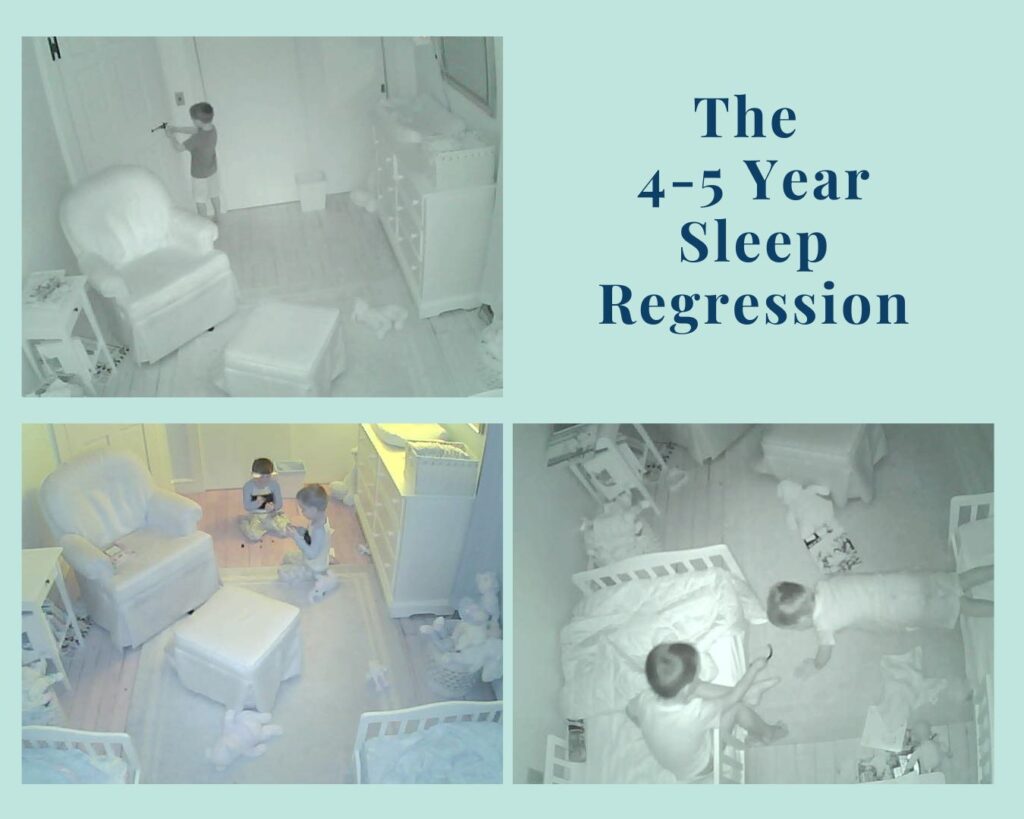
4-5 Year Sleep Regression (4-5 years)
Even preschoolers aren’t immune to sleep regressions! This is a common timeframe when I work with parents!
What’s happening: School transitions, social development, and cognitive leaps can all impact sleep. Children this age may also experience more complex dreams and fears.
Many children also become more aware of world events or family stressors at this age, which can manifest as sleep issues.
Signs to watch for:
- Bedtime anxiety or worry
- Waking with nightmares or night terrors
- Wanting to sleep with parents or parental presence at bedtime
- Early morning wakings
Tips for survival:
- Talk through fears during the day, not at bedtime
- Create a relaxing bedtime routine that addresses anxiety (gentle massage, guided meditation)
- Discontinue screens 1 hour before bedtime and keep an eye on what types of content your preschooler is being exposed to
- Consider a weighted blanket for anxious children
Real talk: After a long spell of rough bedtimes and I was ready to rip my hair out, I remember this company sent me a screen-free meditation device to test out to see if I wanted to recommend it to families. The Zenimal was a GAME CHANGER almost immediately. I put it on for them at bedtime and they fell asleep peacefully without leaving their room, even once! If you want to try this out with your child, you can purchase it here and use discount code BELLALUNAFAMILY for a 5% discount. (affiliate link)

When Troubleshooting Baby Sleep Isn’t Enough: When to Seek Help
While sleep regressions are normal parts of baby development, sometimes sleep issues indicate other concerns. Consider asking for help if…
- You notice breathing issues during sleep (snoring, mouth breathing, long pauses) – call your pediatrician for a well-child to ensure your child doesn’t have an obstructed airway due to enlarged tonsils or adenoids
- Sleep problems persist beyond 2 weeks – this may indicate new patterns have formed and we need to develop a plan to get your child back on track
- Your child has never slept well and it is affecting their behavior and your family unit as a whole
My twins were six months old when I broke down and started looking for baby sleep help. It’s one of the best things I ever did because my twins are amazing sleepers to this day!
So whether your baby won’t sleep suddenly and it’s not getting better or they’ve never slept well, remember, you don’t have to live like this and we can help! Book a free discovery call here and let’s talk about working together.
P.S. Want to stay connected?
Sign up to receive our monthly "Scoop" email newsletter!