articles
Parent Sleep Deprivation: How Tired Parents Can Finally Prioritize Rest in 2026


“Okay, so my baby is sleeping now, woohoo! But wait, now I still can’t sleep, what’s that about??” Three words: parent sleep deprivation.
If this sounds familiar, you’re not alone. This is an issue we’ve heard from countless families after they’ve graduated from our sleep training program. The good news? Your baby sleeping through the night is a huge milestone. The challenging news? Chronic parent sleep deprivation doesn’t just flip off like a light switch the moment your baby starts sleeping. And in 2026, we’re finally having honest conversations about why parent sleep matters just as much as baby sleep.
Getting your baby on a good sleep schedule is one of the best feelings in the world. However, when families have struggled with their child’s sleep issues for months (or even years), many parents find that their own sleep patterns remain disturbed long after sleep training ends. Your nervous and adrenal systems can become so stressed and dysregulated that your body literally forgets how to fall and stay asleep. You might find yourself:
- Lying awake, anxiously listening for the baby monitor even though your baby is sleeping soundly
- Waking up at 2 AM out of pure habit, unable to fall back asleep
- Feeling wired and exhausted at the same time
- Struggling with brain fog, irritability, and emotional dysregulation even after getting “enough” sleep
One mom described it perfectly: “My body forgot how to fall and stay asleep. I constantly woke in the night, anxious that I heard the baby wake—even when she didn’t.”
Here’s what we now know in 2026...
The cultural shift toward prioritizing parent mental health isn’t just a trend. It’s backed by mounting research showing that chronic sleep deprivation is one of the most significant risk factors for parental burnout, postpartum mood disorders, and long-term health consequences.
The consequences of sleep deprivation for parents (and all humans) extend far beyond feeling groggy. Recent 2025 research shows that sleep loss impacts every aspect of our lives—physical health, mental wellbeing, emotional regulation, and even our ability to parent positively.
Let’s explore the real toll of sleep deprivation and, more importantly, how parents can finally reclaim restorative sleep in 2026.
Jump To:
Helping Parents Improve Their Sleep
The Real Toll of Parent Sleep Deprivation on Mental Health
- Cognitive Impairment: Lack of sleep hampers cognitive functions such as attention, concentration, and decision-making. It affects memory consolidation, hindering the brain’s ability to retain and process information efficiently.
- Physical Health Complications: Sleep deprivation takes a toll on physical health, leading to an increased risk of heart disease, obesity, diabetes, hormone dysregulation and weakened immunity.
- Emotional Instability: Sleep deprivation can significantly impact mood, causing irritability, mood swings, and heightened emotional reactivity. Long-term sleep issues may contribute to the development of anxiety disorders and depression.
The Hidden Mental Load: Decision Fatigue and Emotional Dysregulation
NEW research in 2025 reveals what exhausted parents have known all along…chronic sleep deprivation doesn’t just make you tired—it fundamentally changes how your brain processes stress, decisions, and emotions.
The Parent Sleep-Mental Health Connection
A comprehensive 2025 umbrella review analyzing 29 systematic studies confirmed that sleep deprivation creates a cascade of mental health challenges, including:
Emotional Dysregulation: Sleep loss decreases functional connectivity between your prefrontal cortex (the rational “thinking” part of your brain) and your amygdala (the emotional “feeling” center). Translation? You’re more likely to snap at your toddler over spilled Cheerios or cry over something small because your brain literally can’t regulate emotions as effectively.
As Healthline reports, sleep deprivation sends your stress hormones skyrocketing and impairs your ability to think clearly and regulate your emotions.
Heightened Anxiety and Depression Risk: Recent research from Stanford Medicine shows that people with chronic insomnia are 10 times more likely to experience depression and 17 times more likely to have anxiety compared to well-rested individuals. For parents already navigating the stress of raising children, sleep deprivation compounds these risks significantly.
Sleep deprivation is linked to over 500,000 cases of postpartum depression annually—getting support for your sleep can be a critical part of protecting your mental health.
Decision Fatigue Spiral: When you’re sleep-deprived, your brain struggles with executive function—the ability to make decisions, prioritize tasks, and solve problems. This is why choosing what to make for dinner can feel like an impossible task when you’re exhausted. And here’s the kicker: parenting requires hundreds of micro-decisions every single day.
The “I’ll Sleep When They’re in College” Myth: Many parents wear exhaustion like a badge of honor, believing that sacrificing their own sleep is part of being a good parent. But 2026 research makes it clear: you cannot pour from an empty cup. Your sleep directly impacts your ability to be patient, present, and emotionally available for your children.
Breaking the Guilt Cycle
One of the biggest barriers to parent sleep in 2026? Guilt.
Parents—especially mothers—often feel selfish for prioritizing their own sleep. You might think:
- “My baby needs me” or
- “I should be able to handle this” or
- “Other parents seem fine on less sleep.”
But here’s the truth backed by science: Prioritizing your sleep isn’t selfish—it’s essential for your family’s wellbeing. When you’re well-rested, you’re:
- More patient and emotionally regulated with your children
- Better able to make sound parenting decisions
- More present and engaged during quality time
- Physically healthier and more resilient to illness
- Less likely to experience mood disorders, burnout, or relationship conflict
Think of it this way: When flight attendants tell you to put on your own oxygen mask before helping others, they’re not encouraging selfishness—they’re ensuring you’re capable of helping. The same principle applies to sleep.
Yikes. Now that your little one is sleeping, we’ve got to get you sleeping NOW! These tips should help…
How Tired Parents Can Finally Recover from Parent Sleep Deprivation in 2026
So let’s talk about evidence-based strategies for you to improve your rest after chronic sleep deprivation. These aren’t just “nice to try”—they’re essential tools for recovering from months or years of sleep loss:
Consistent Sleep Schedule
Establish a regular sleep routine by going to bed and waking up at the same time every day, even on weekends. (this is good to model for your little one too, to keep their sleep on track). This helps regulate the body’s internal clock, promoting better sleep quality.
Why this matters in 2026: A 2025 study found that sleep regularity (going to bed and waking at consistent times) matters even more than sleep duration for mental health outcomes. Your circadian rhythm craves predictability—give it that gift.
Create Your Own Bedtime Routine
If you are falling asleep on the couch, waking up later and climbing into bed, your sleep quality is going to be poor and you’ll likely have a difficult time settling back to sleep.
So instead, once you’ve established your regular sleep schedule, begin a bedtime routine 30 minutes before you want to settle into sleep. Think of things like showering or washing your face; a skincare routine (your post new-Mom self will thank you!), brushing your teeth and flossing, reading and a sleep meditation. The consistent set of activities that prepare and cue your little one’s body for sleep will work the same magic on you! You can learn more about designing a bedtime routine for yourself and your child here.
Parent-specific tip: Your bedtime routine is teaching your nervous system “it’s safe to sleep now.” After months of being hyper-vigilant listening for your baby, your body needs intentional cues that it’s okay to let your guard down.
Create a Relaxing Sleep Environment
At Bella Luna when we coach parents about their children’s sleep, we focus a whole lot on the baby’s environment. But just like your little human loves a dark, quiet, cool sleep environment, your grown-up body depends on that just as much.
My husband and I ended up buying the same industrial-strength blackout curtains our has in her room. They’re now a beloved part of our family!
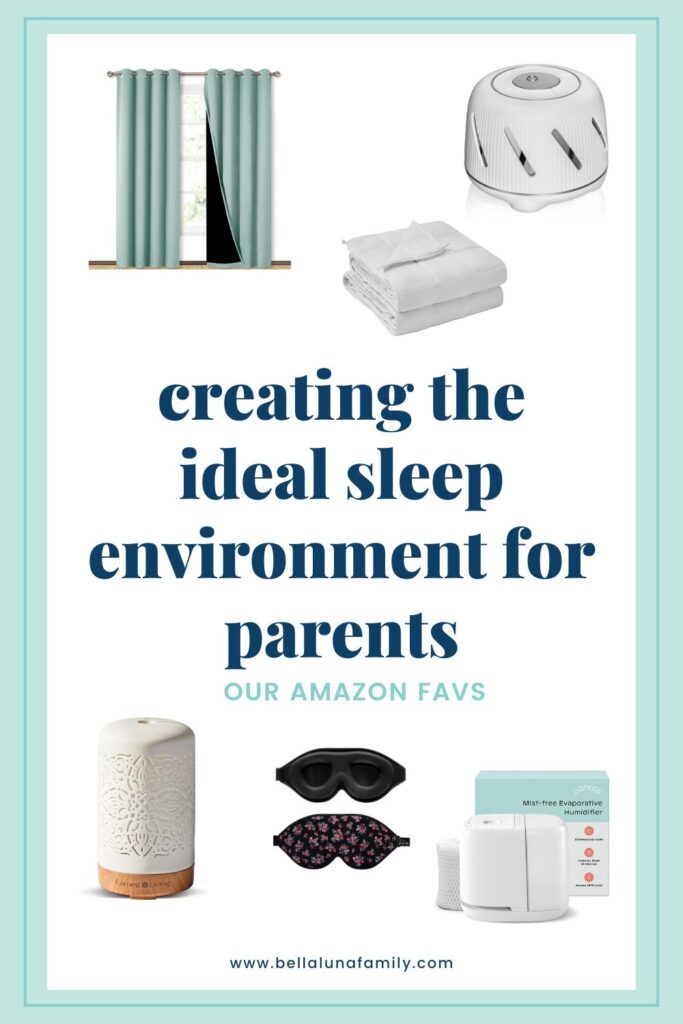
Make it a weekend activity to *sleepify* your bedroom (aka a mandatory trip to Target or peruse our favorite products on Amazon!). Things to consider:
- Make the room as dark as humanly possible
- Ensure the room is cool (68-72F)
- Add your own sound machine
- Essential oil diffusers can be lovely for an adult’s bedroom, with scents like lavender or chamomile.
- Weighted blankets are also great for adults, to cocoon and settle stressors.
Other things to consider as you make your bedroom a haven for sleep:
- Is your mattress still comfortable or do you wake up sore every morning? When was the last time you replaced your mattress?
- Are your sheets soft and made from breathable material?
Maybe it’s time for some upgrades if you didn’t answer yes to the two questions above!
Limit Screen Time
I know, I know, you’ve heard it before but this time we really mean it…
It’s super important to reduce exposure to screens, particularly before bedtime. The blue light emitted by devices can suppress the production of melatonin, a hormone crucial for sleep regulation. Ideally, we want at least 30-60 minutes before you want to fall asleep without screentime so your body can produce the hormones necessary for you to fall asleep.
Switch screentime out with a book, adult coloring pages, or a good old-fashioned magazine your teenage self would’ve loved to browse on the beach.
If you have to work late, ensure you have blue light-blocking glasses. Another tip to help is to ensure that you have the Night Mode turned on your phone, which will make the screen warmer-toned in attempt to have less effect on melatonin production.
But seriously, just put it down!
The 2026 reality check: We know—telling exhausted parents to put down their phones feels unrealistic. This might be your only “me time” all day. Here’s the compromise: If you must scroll, do it 60-90 minutes before you want to fall asleep, not in bed. Use blue-light blocking glasses or enable Night Mode. Even better? Swap 15 minutes of scrolling for 15 minutes of reading an actual book or magazine.
Practice Relaxation Techniques
Try out some relaxation methods like meditation, deep breathing exercises, or gentle yoga before bedtime to calm the mind and prepare the body for sleep. YouTube turns out to be a haven for guided relaxation and sleep meditations (including one read by Harry Styles. YES I’M SERIOUS!).
Healthy Sleep Habits
Avoid caffeine and heavy meals close to bedtime. Instead, opt for a low glycemic index snack. Also, tea. The Irish are onto something here guys– tea can be a pretty magical balm at the end of each day. Think Chamomile, Sleepytime, decaf vanilla.
Split Your Time
If you live with a partner or support person, designate shifts for the night. For example, if you handle any child waking/nighttime need from 7 PM-12 AM, your partner takes the 12 AM-7 AM shift. This can be incredibly settling for your subconscious nervous system to know that it’s not “on duty” at all times.
Why this is trending in 2026: “Split-shift parenting” has become one of the top parenting strategies in 2026, with parents increasingly dividing responsibilities so each parent gets consolidated blocks of sleep rather than both being perpetually exhausted. This approach is more sustainable long-term and helps both parents maintain their mental health.
How to implement split shifts:
Accept that this might mean less couples time in bed together temporarily—but you’ll be healthier partners when you’re both rested
Communicate clearly about who’s responsible for what hours
The “off-duty” parent should use earplugs, a sleep mask, or even sleep in a different room if needed to truly disconnect
Rotate shifts weekly if one feels less sustainable
Consider a “do not disturb” sign on your bedroom door during off-duty hours
Write it Out
For a lot of people, racing thoughts can greatly impair attempts to fall asleep and stay asleep (and these thoughts may even be subconscious). Before bedtime, journal or try what my high school English teacher called a ‘Ten Minute Spill,’ where you simply grab a piece of paper and pencil and write out anything (no matter how nonsensical) that pops into your head, letting the words flow for a full five or ten minutes.
Seek Professional Help if Needed
If sleep issues persist (in particular chronic insomnia and nighttime anxiety) despite attempts to improve sleep hygiene, do not hesitate to reach out to a doctor or therapist.
If sleep issues persist—particularly chronic insomnia, nighttime anxiety, or intrusive thoughts that prevent sleep—do not hesitate to reach out to a doctor or therapist.
When to seek help immediately:
- You have thoughts of harming yourself or your baby
- You experience panic attacks related to sleep or nighttime
- Insomnia persists for more than 3-4 weeks despite trying these strategies
- You suspect you may have postpartum depression or anxiety
Remember: Seeking help is a sign of strength, not weakness. Sleep deprivation is linked to over 500,000 cases of postpartum depression annually—getting support for your sleep can be a critical part of protecting your mental health.
To conclude…
Your Sleep Matters: A 2026 Wake-Up Call
Sleep is not a luxury—not even for parents. It’s a fundamental pillar of your overall health, wellbeing, and ability to show up as the parent you want to be.
The 2026 cultural shift we’re seeing in parenting is powerful: Parents are rejecting the “martyr mentality” and embracing the reality that taking care of yourself IS taking care of your family. You’re not being selfish by prioritizing sleep. You’re modeling healthy boundaries and self-care for your children.
Addressing your own sleep deprivation requires dedication and consistency. By adopting healthy sleep practices and—here’s the important part—releasing the guilt around prioritizing your rest, you can reclaim restorative sleep and revitalize your physical health, mental wellbeing, emotional stability, and ability to parent positively.
Your action steps:
- Choose 2-3 strategies from this post to implement this week
- Communicate with your partner (if applicable) about split-shift arrangements
- Set a realistic bedtime and stick to it for 7 days
- Give yourself grace—recovery from chronic sleep deprivation takes time
- Reach out for professional support if you need it
Remember: Every hour of sleep you prioritize is an investment in yourself and your family. You deserve rest. Your baby is sleeping—now it’s your turn.
Want more support with your family’s sleep journey? Schedule a free discovery call to learn how we can help create a comprehensive sleep plan that works for your entire family—including YOU.
If you want to learn more about adult sleep, join our Adult Sleep newsletter for evidence-based insights and strategies delivered to your inbox.
P.S. Want to stay connected?
Sign up to receive our monthly "Scoop" email newsletter!